
Australian Government releases guidance on adoption of AI in the workplace
Authors: Zeb Holmes, Sanjay Alapakkam and Ayesha Memon
Today, artificial intelligence (AI) is transforming the way in which Australians work. Simultaneously, employee sentiment has noticeably shifted from enthusiasm about AI’s possibilities to growing anxieties regarding the potential displacement of jobs, spurred by announcements of job losses by major companies including Microsoft, Qantas, Canva and Atlassian. In 2025, a study conducted by Jobs and Skills Australia found that in the medium term, AI is more likely to augment employees’ work rather than replace it through automation. This is likely to result in the creation of additional tasks within employees’ jobs as well as the integration of AI into certain aspects of their work, creating significant changes for Australian employees.
Addressing these uncertainties, on 12 November 2026, Minister for Employment and Workplace Relations Amanda Rishworth delivered a speech at the Australian Financial Review’s AI Forum, announcing the release of the Government’s first draft Best Practice Guide on the Adoption of AI in the Workplace (Draft Guide). Rishworth indicated that the Draft Guide is designed to provide a ‘practical road map’ for employers to make “the most of their AI investment in partnership with their workforce”.
What is the Best Practice Guide?
The Draft Guide is the product of multiple roundtables and forums with unions, academics and employers and their representatives. In an interview with the Australian Broadcasting Corporation, Rishworth recognised that AI adoption is actively taking place across Australian workplaces, with the Government’s thinking being around “How do we make sure people are supported, that they have the capability, and that companies are actually planning that if a job is automated that there is some opportunity to take up a different role, different tasks within that company”.
The Draft Guide emphasises that workers should be placed at the centre of the adoption process. Recognising that AI adoption contributes to workforce transformation and enhances Australian workplaces, the Government intends to ensure that both businesses and the workers can share the benefits and opportunities presented by AI.
Importantly, while the Draft Guide does not create or expand any legal obligations, its recommendations are influential and are expected to be used by unions as benchmarks in industrial disputes. Further, they may be indicative of a broader paradigm shift in future government policymaking.
The Draft Guide is underpinned by three key pillars to assist workplaces in making the most of the opportunities that AI offers. These pillars are “Plan”, “Enable” and “Embed”, and are together characterised by eight principles as set out in the Draft Guide.
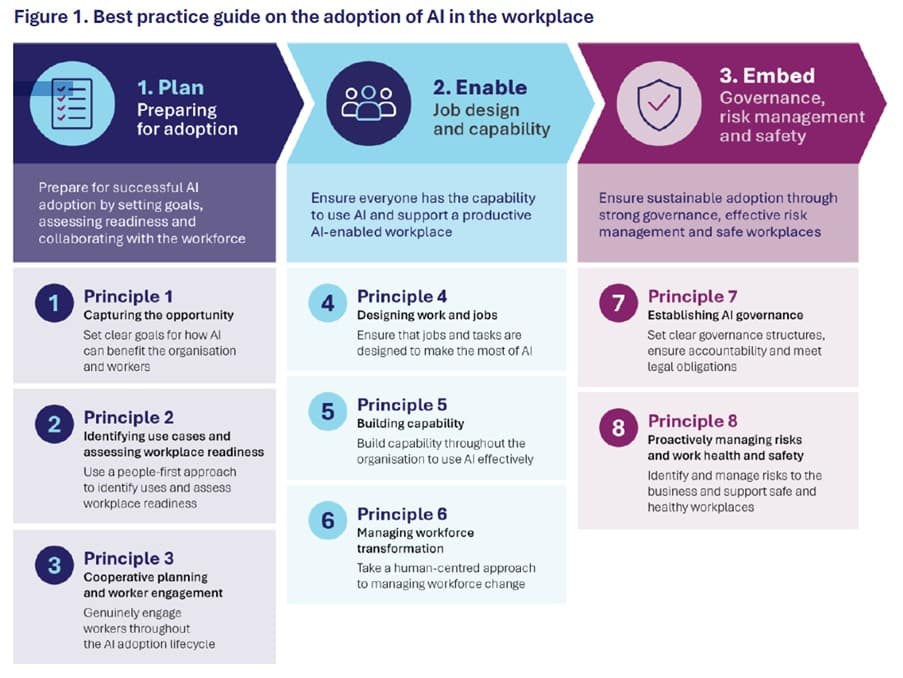
Draft Guide, page 7
Trust as a foundation for AI adoption
The Draft Guide emphasises the need to build trust to enable the successful adoption of AI in the workplace, which resonates with the Government’s parallel messaging about the need for a social licence for AI in the context of safety and national security.
The Draft Guide sets out that building trust “requires ongoing attention to transparency, fairness, accountability, capability, human oversight, explainability, contestability, reliability and safety, supported by genuine workplace engagement. A lack of trust in any of these areas can contribute to broader workplace distrust and resistance to AI adoption”. This can extend from the use of AI in hiring and firing employees to day‑to‑day functions that may help or hinder or usurp employees’ roles.
Key Takeaways for Employers
- Watch this Draft Guide and the submissions process closely. At this stage, the Draft Guide is in draft form with submissions invited until 27 January 2027.
- Review AI scoping and implementation processes and ensure a collaborative process between employees and management in order to maximise overall value for workers and businesses and minimise any adverse effects on workplace stress, uncertainty and motivation.
- Review and ensure security and confidentiality protocols, and ensure users of AI in the workplace are bound by adequate protocols.
- Ensure that changes to assessing workers’ performance are fair and sustainable and account for the limitations of AI and the strengths of your workers.
If you require legal advice or assistance, please contact our Harmers team at +61 2 9267 4322.
© Harmers Workplace Lawyers


